

Sunday Planning: How To Plan For A Productive Week
Do Sunday evenings leave you feeling anxious instead of calm?
The laundry isn’t done. The week feels unclear. Your mind is racing.
A simple Sunday planning routine can completely shift how your week begins.
Sunday planning is the ultimate way to eliminate the Sunday Scaries! Turn your Sunday evening into a powerful tool for gaining back work-life balance!
The Benefits of Sunday Planning
First off, let’s chat about why Sunday planning is the key to a successful week.
Picture this: instead of starting your Monday morning in a whirlwind of stress and last-minute tasks, you glide into your week with a clear plan and peace of mind.
Sounds dreamy, right? That’s the magic of Sunday planning.
Creating your own Sunday planning system is the ultimate way to master your time management and start your new week with a clear view of your whole week in your planner.
You will find you have more time for the things you love, whether that’s a passion project you’ve been neglecting, quality time with your loved ones, or just some well-deserved me-time (like these self-care Saturday ideas).
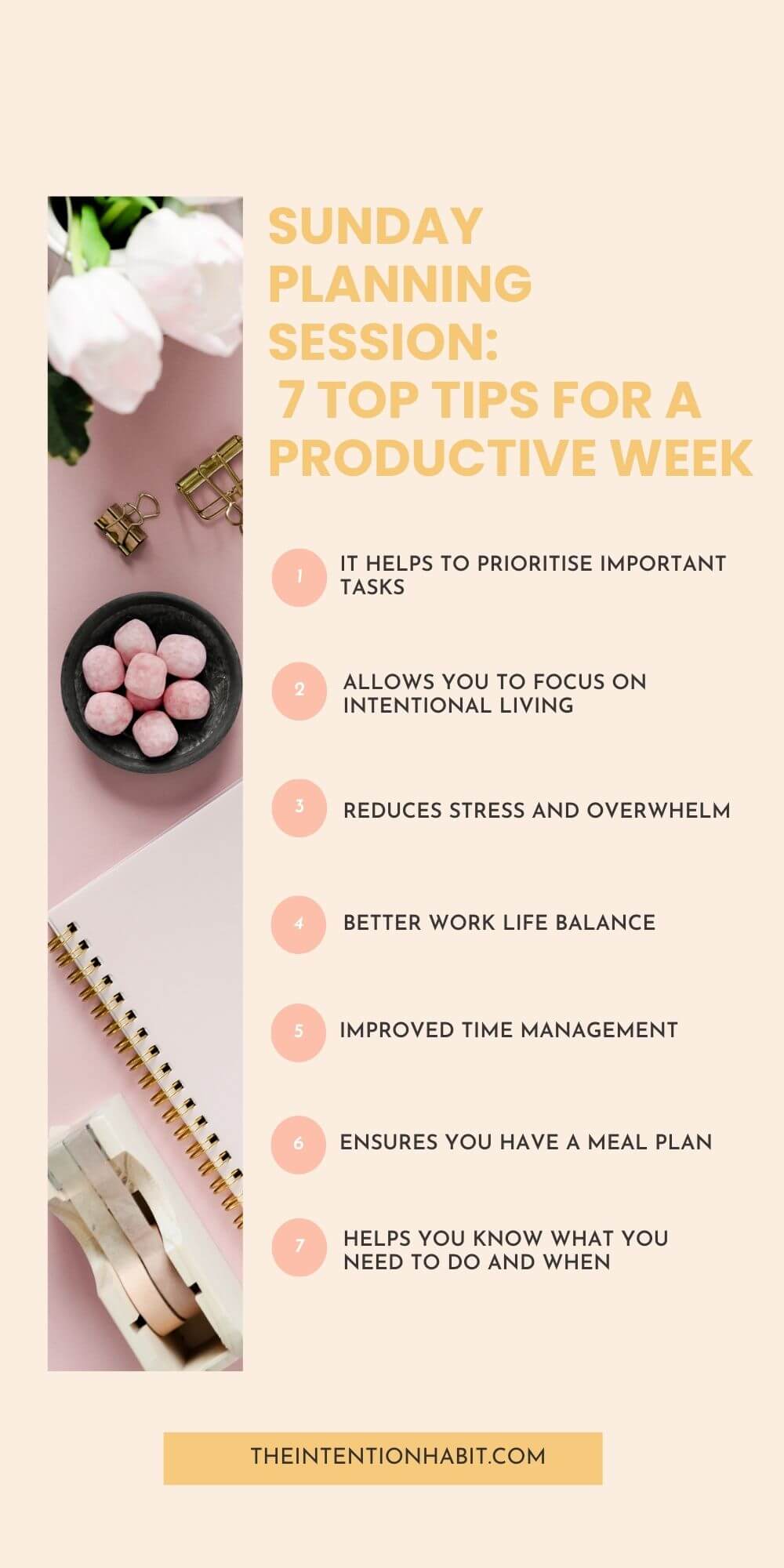
- It helps you to prioritise important tasks
- Allows you to focus on intentional living
- Reduces stress and overwhelm
- Better work life balance
- Improved time management
- Ensures you have a meal plan for the week ahead
- Saves time by knowing what you need to do and when
Sunday Planning vs Sunday Reset
Often a Sunday reset and Sunday planning session are used interchangeably, and they can be done together, but there is a little difference between the two:
A Sunday reset focuses on your environment — laundry, cleaning, prepping meals.
Sunday planning focuses on your mind — clarity, priorities, and reducing mental load.
When you combine both, you walk into Monday feeling calm instead of chaotic.
How To Do Weekly Planning On A Sunday
Alright, let’s get down to the nitty-gritty of Sunday evening planning.
The process of Sunday planning should not take you very long. It is something you can do on a Sunday night, Sunday afternoon or even on a Sunday morning. Built it into your Sunday routine at a time that makes sense to you.
This dedicated time will take less time each week as you get into the good habits of planning your week ahead.
Here’s your step-by-step guide to planning your week like a boss on a Sunday:
1. Review Your Previous Week
Start by reflecting on the past week.
What went well? What could have been better?
Celebrate your wins (yes, even the small ones!) and learn from the things that didn’t go so well, such as the things you didn’t get done because you underestimated the time they took, or unexpected events and disruptions in your week that you couldn’t prepare for.
The process of reviewing your week is also a good opportunity to review your current goals.
Take a moment to consider your goals and what steps you took towards achieving them.
Did you move forward on any of your goals? Why? Why not? How can you better plan to do this in the week ahead?
2. Check Your Calendar
Next, take a look at your calendar for the upcoming week.
Note any appointments, deadlines, or events. Add these non-negotiable items to your daily planner pages or Google calendar, ensuring you have allowed a big enough time block for each of the items.
This is always the essential first step in planning your new week since there is no point in spending time adding your important tasks to your days if you haven’t first checked how much time you have available each day that week.
3. Prioritise Your To-Do List
Now, it’s time to tackle that to-do list. Do a brain dump for the entire week ahead with all of your weekly priorities and weekly goals.
This should include both personal and professional life priorities for the upcoming week.
Write down everything you need to do in the coming week, then prioritise these tasks.
Focus on what’s most important and urgent.
The key to creating a balanced schedule is first knowing how much available time you have each day before loading it up with tasks that take more than the time you have to spare.
This is the fastest track to burnout and overwhelm!
Put your most important task at the top and repeat this process until all of your must items are in order.
4. Schedule Your Days
Once you have your prioritised to-do list, start scheduling your days.
Allocate specific times for each task, but make sure to leave some buffer time for unexpected interruptions or tasks that take longer than anticipated.
This is almost always guaranteed to happen – especially if you’re a parent or you work in a role that comes with many unexpected distractions.
How you schedule your days depends on your preferences. You won’t always schedule your top priority task for a Monday if your Monday is already loaded up with set appointments and scheduled events.
But do aim to put the most important things towards the start of your week – front-load the productive things you NEED to get done. This allows room later in the week if things don’t go exactly as planned.
Don’t forget to pencil in time for self-care activities, hobbies and relaxation. You’re not a robot!
When Scheduling Your Week:
- Front-load important tasks.
- Leave buffer space daily.
- Avoid stacking high-focus tasks back-to-back.
- Protect at least one lighter day.
5. Create Your Meal Plan
Planning your meals ahead of time can save you loads of stress (and saves you money!). As such, meal planning should be part of your Sunday night planning.
The best first step in meal planning is to see what you already have in your home.
Do this by checking your refrigerator for any fresh ingredients that need to be used soon. These should take priority for your start-of-the-week meals.
Then check your pantry and your freezer to see what food you already have.
Shopping first from your available food is a great way to keep your costs down and it helps avoid turning to junk food or takeaway…
TIP: One of my favourite ways to meal plan is to have a list of favourite family meals to draw from – a master recipe list. This means we can choose meals that we already know how to make and don’t feel the pressure of trying something new every day.
6. Create Your Grocery List
Based on your meal plan, create a grocery list. This will ensure you have all the ingredients you need for the week and help you avoid those last-minute, panic-induced trips to the supermarket.
This meal prep process should also include snacks, so you can create your planned menu and have healthy options for between meals.
You might even like to do your weekly grocery shop on a Sunday as part of your Sunday planning system.
I order groceries online so I often do my weekly shop on a Sunday night for Monday morning delivery.
7. Review Your Weekly Plan
Now that you’ve done your time block for the productive week ahead and planned your meals for each day of the week, you can review your schedule.
This is your chance to make sure that your weekly plan is realistic and that you have allowed enough time for everything you need to get done.
If there isn’t enough time, what can you move to the following week or outsource?
This also gives you a chance to review your free time and consider ways to prioritise self-care and family time in your week.
Plan for energy, not just tasks:
- Protect recovery after busy days
- Avoid overbooking evenings
- Schedule white space
- Plan for school/work rhythms
8. Prepare For Monday
Finally, prepare for your Monday.
This could include laying out your clothes for the morning, prepping your breakfast, or setting your alarm.
If you have kids, it might look like packing school bags and ironing uniforms or having a family meeting to ensure the whole family knows what is ahead.
When Monday morning feels calm, your entire week feels lighter. A few small Sunday decisions remove dozens of Monday micro-stresses.
The 20-Minute Sunday Planning Version
Short on time? Do this:
- 5 min quick meal plan
- 5 min brain dump
- 5 min calendar check
- 5 min choose 3 priorities
Tips for Effective Sunday Night Planning
To wrap things up, here are a few tips to make your Sunday night planning effective:
- Be realistic: Don’t over-schedule yourself. It’s better to accomplish a few tasks well than to half-do a dozen.
- Stay flexible: Life happens, and plans change. Be ready to adapt your plan as needed.
- Keep it simple: Your plan should be easy to understand and follow. Don’t complicate things unnecessarily.
- Be consistent: Make Sunday planning a habit. Consistency is key to reaping the benefits!
Conclusion: Your Sunday Planning System
Sunday planning isn’t about becoming hyper-productive.
It’s about removing unnecessary stress before it starts. It’s about choosing intention over chaos.
When Sunday feels calm, Monday follows. And sometimes that’s all you need.
You might also like:
- Monthly goal ideas
- Growth mindset affirmations
- How to create an effective morning routine
- Weekly self-reflection questions


